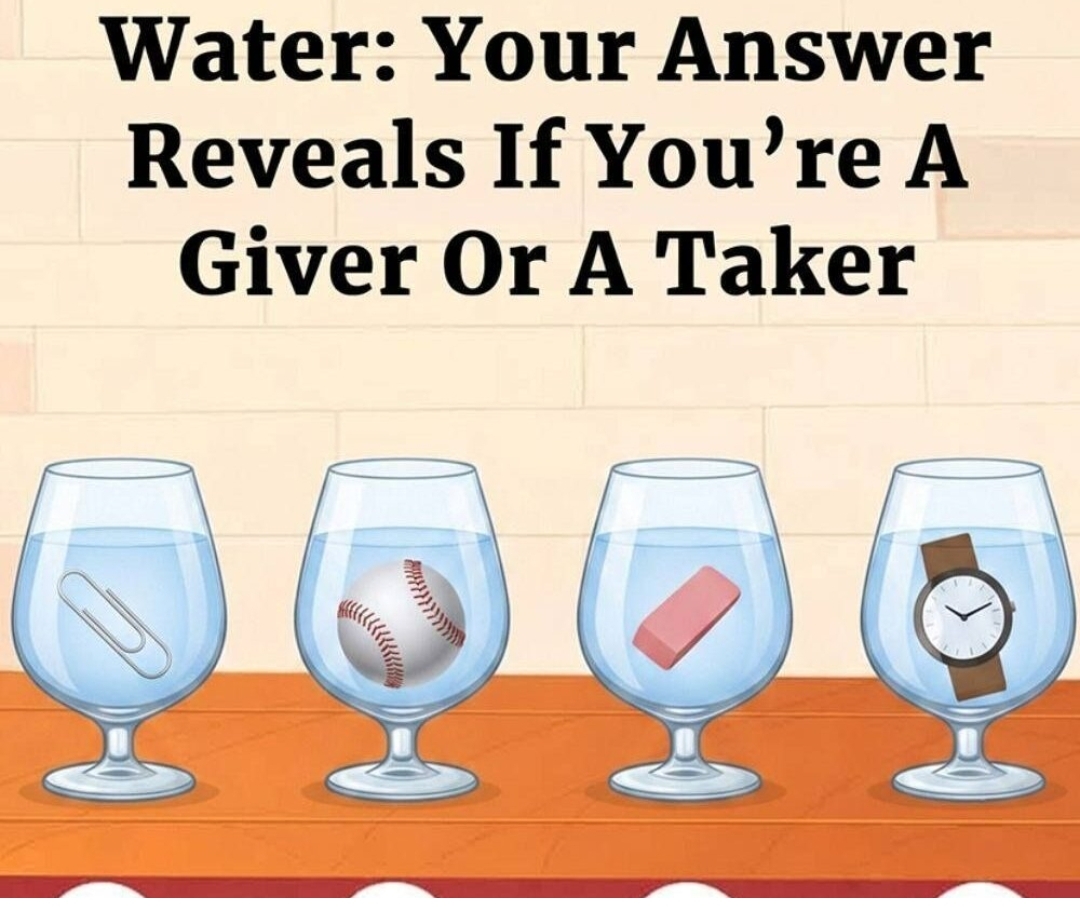
Which Glass Holds the Most Water? The Viral Puzzle That Claims to Reveal Your PersonalityEngaging IntroductionAt first glance, the puzzle looks almost too easy.Four identical glasses sit side by side, each filled to exactly the same water level. Inside each glass is a different object — a paperclip, a coin, a marble, and a cork. The challenge sounds simple: Which glass actually contains the most water?But then something strange happens.People start arguing.One person insists they’re all equal because the water levels match perfectly. Another immediately chooses the smallest object. Someone else starts talking about buoyancy and density like they’re suddenly teaching physics class. And before long, the conversation shifts from science to personality.Because this puzzle isn’t just about water.It’s about perception. About what we notice — and what we overlook. It asks whether you focus on appearances or hidden variables. Logic or instinct. Surface or depth. And somehow, a few glasses of water become a mirror reflecting how we move through relationships, work, and everyday life.Why You’ll Love This PuzzleFun and easy brain teaser anyone can tryTeaches simple physics in a fascinating waySparks conversation at parties and gatheringsExplores personality and perceptionHelps you think beyond first impressionsThe Puzzle: Which Glass Has the Most Water?Imagine four identical glasses filled to the exact same visible water level.Each glass contains a different object:Glass A: A small paperclipGlass B: A coinGlass C: A marbleGlass D: A corkThe question:Which glass actually contains the most water?At first, many people assume the answer is:“They all contain the same amount.”After all, the water levels look identical.But the puzzle hides an important detail.The Secret: Water DisplacementThe objects inside each glass take up space.That means the water level rises depending on how much space the object displaces.The larger the submerged object, the more room it occupies — and the less actual water remains inside the glass.So if every glass has the same visible water level:Bigger object = less waterSmaller object = more waterWhich means:The glass with the smallest submerged object contains the most water.In most versions of the puzzle, that would be the paperclip.The Physics Explained SimplyHere’s the science behind it.When an object is placed into water, it pushes water aside. This is called displacement.Larger Objects Displace More WaterA marble occupies more space than a paperclip, so the marble pushes more water upward.That creates the illusion that the glass contains just as much water — even though some of the volume now belongs to the object itself.Smaller Objects Leave More Room for WaterBecause the paperclip takes up very little space, the glass can hold more actual water while still reaching the same level.That’s why the smallest submerged object usually means the most water.What About the Cork?This is where the puzzle gets interesting.A cork floats.Floating objects behave differently because they only displace water equal to their own weight, not necessarily their full volume.So depending on the exact size and density of the cork, some people argue the cork glass could actually contain more water than expected.That answer usually comes from analytical thinkers who consider:DensityBuoyancyFloating displacementHidden variablesAnd honestly… they’re not wrong for thinking deeper.What Your Answer “Says” About YouNow comes the viral personality-test part.To be clear:This is not scientific psychology.But it’s fun, emotionally relatable, and surprisingly thought-provoking.If You Chose the Smallest ObjectYou may be a giver.You naturally look beneath the surface and notice hidden details other people miss.You understand:Quiet effortInvisible workEmotional nuanceSubtle signalsIn relationships, you’re often the person who notices someone struggling before they ask for help.Your StrengthEmpathy and awareness.Your Blind SpotYou may give so much to others that you neglect yourself.If You Said All the Glasses Are EqualYou may be a realist or perfectionist.You trust what you see and value fairness, balance, and consistency.You prefer:Clear rulesHonest communicationStabilityEqual treatmentYour StrengthReliability.Your Blind SpotYou may overlook hidden emotional dynamics or unspoken effort.If You Chose the Largest ObjectYou may be more opportunity-driven.You focus on what appears biggest, strongest, or most obvious.That can make you:AmbitiousStrategicPracticalCompetitiveYour StrengthConfidence and decisiveness.Your Blind SpotYou may underestimate quieter forms of value.Sometimes the smallest things matter most.If You Focused on the Cork FloatingYou may be an analytical thinker.You didn’t stop at appearance or even object size. You considered:PhysicsDensityMaterial behaviorSystems thinkingYour StrengthDeep analysis.Your Blind SpotOverthinking simple situations.Sometimes not every puzzle hides another layer.Why This Puzzle Became So PopularThis puzzle spreads online because it combines three powerful things:1. Simple Visual DesignAnyone can understand it instantly.2. A Surprise TwistThe answer challenges first impressions.3. Emotional MeaningThe personality interpretation makes people feel understood.Even though the “giver vs. taker” idea isn’t scientifically proven, it resonates emotionally because people enjoy discovering hidden meaning in their choices.That emotional connection is what makes people share it.The Real Lesson Behind the PuzzleThe most important takeaway isn’t whether you answered correctly.It’s learning to pause before assuming appearances tell the whole story.Because life works exactly like these glasses.Two people may seem equally successful — but one may be carrying invisible burdens.Two coworkers may appear equally productive — but one may quietly do far more behind the scenes.Two friendships may look balanced — while one person gives much more emotionally.The water level looks the same.But hidden variables change everything.Why Perspective Matters in Everyday LifeThis puzzle reminds us to ask:What am I not seeing?That question changes relationships, communication, and empathy.Sometimes:The quietest person is hurting the mostThe calmest person carries the heaviest stressThe smallest contribution matters mostThe ability to notice hidden displacement — in people, situations, and emotions — is often what separates surface thinking from deeper understanding.Fun Facts About Water DisplacementArchimedes Discovered the Principle Over 2,000 Years AgoThe famous Greek mathematician used water displacement to measure volume.Ships Float Because of DisplacementEven massive ships stay afloat by displacing enough water.Floating Objects Behave DifferentlyFloating items only displace water equal to their weight.Your Body Displaces Water TooThat’s why water levels rise when you step into a bathtub.Frequently Asked QuestionsWhich glass actually contains the most water?Usually the glass with the smallest submerged object.Why doesn’t the largest object mean more water?Because the object itself takes up space inside the glass.Does a floating cork change the answer?Possibly. Floating objects displace water differently than fully submerged objects.Is the personality interpretation scientifically accurate?No. It’s more of a fun social psychology concept than a scientific assessment.Why do people love puzzles like this?They challenge assumptions and create emotional engagement through interpretation.You May Also LikeViral Brain Teasers That Reveal PersonalityOptical Illusions That Trick Your BrainEasy Psychology Puzzles ExplainedThe Science Behind Everyday IllusionsRiddles That Test Critical ThinkingFun Conversation Starters for PartiesFinal ThoughtsWhat makes this puzzle memorable isn’t really the water.It’s the moment you realize how easily appearances can fool us.A simple row of glasses becomes a lesson about perception, hidden variables, and the difference between seeing and understanding. And whether you approached it emotionally, logically, or analytically, your answer probably revealed less about your personality type… and more about how your mind naturally explores the world.Because sometimes the most meaningful insights come from the simplest questions.Even a glass of water can teach us to look deeper. 💧
Which Glass Has More Water? Your Answer Reveals If You’re a Giver or a Taker